Tuesday, September 29, 2009

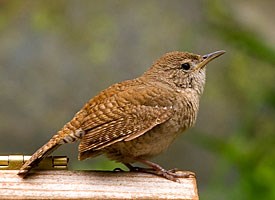
The cute little uncommon, commom house wren


A plain brown bird with an effervescent voice, the House Wren is a common backyard bird over nearly the entire Western Hemisphere. Listen for its rush-and-jumble song in summer and you’ll find this species zipping through shrubs and low tree branches, snatching at insects. House Wrens will gladly use nestboxes, or you may find their twig-filled nests in old cans, boots, or boxes lying around in your garage.The fiesty little birds are everywhere in our yard.

Thursday, September 3, 2009

Tufted Titmouse

This is a tufted titmouse. He is another small
bird that takes each sunflower seed up to a 
branch of a tree to place the seed between
his toes to break the seed open. As soon as he has eaten the seed he comes back for another.
This goes on until he has his fill.
He is gray with a lighter gray belly.


Tuesday, September 1, 2009

The beautiful mourning dove

One of the largest group of birds in our
backyard are mourning doves.
The are native to this area and do not
migrate.
They mate for life and if their mate dies it
is very obvious that they are in mourning.
The nest they build are very sparse and are
not made thick at all.
There are huge fields around where they grow
sunflowers and the doves love these.
The sunflowers are cut down and left on the 
ground so that there are many doves
available during the dove hunting season.
I don't like this practice.



Golden Finches

The Golden Finch is one of the brightest
specimens in our back yard.
The American Goldfinch (Carduelis tristis), also known as the Eastern Goldfinch and Wild Canary, is a North American bird in the finch family. It is migratory, ranging from southern Canada to North Carolina during the breeding season, and from just south of the Canadian border to Mexico during the winter.
The only finch in its subfamily which undergoes a complete molt, the American Goldfinch displays sexual dimorphism in its coloration; the male is a vibrant yellow in the summer and an olive color during the winter months, while the female is a dull yellow-brown shade which brightens only slightly during the summer. The male displays brightly colored plumage during the breeding season to attract a mate.
The American Goldfinch is a granivore and adapted for the consumption of seedheads, with a conical beak to remove the seeds and agile feet to grip the stems of seedheads while feeding. It is a social bird, and will gather in large flocks while feeding and migrating. It may behave territorially during nest construction, but this aggression is short-lived. Its breeding season is tied to the peak of food supply, beginning in late July, which is relatively late in the year for a finch. This species is generally monogamous, and produces one brood each year.
Human activity has generally benefited the American Goldfinch. It is often found in residential areas, attracted to bird feeders installed by humans, which increases its survival rate in these areas. Deforestation by humans also creates open meadow areas which are the preferred habitat of the American Goldfinch.
Photo from the web.


This is our picture of the Golden Finch in 
at our feeder.
I had to zoom in on this and it is not a very good photo, sorry.
They are too fast for my photographer.
Click on and you can see Goldie at feeder.